
What Causes Employee Resistance to New Initiatives
If you're leading an ERP rollout or introducing AI into frontline work, you've probably heard this: "People just don't like change."
That story is convenient. It's also wrong.
Most employee reluctance isn't about disliking change. It's about protecting the work and protecting themselves from a system that threatens reliability, competence, and outcomes. This matters especially when a new technology sits directly between an employee and the result they're accountable for.
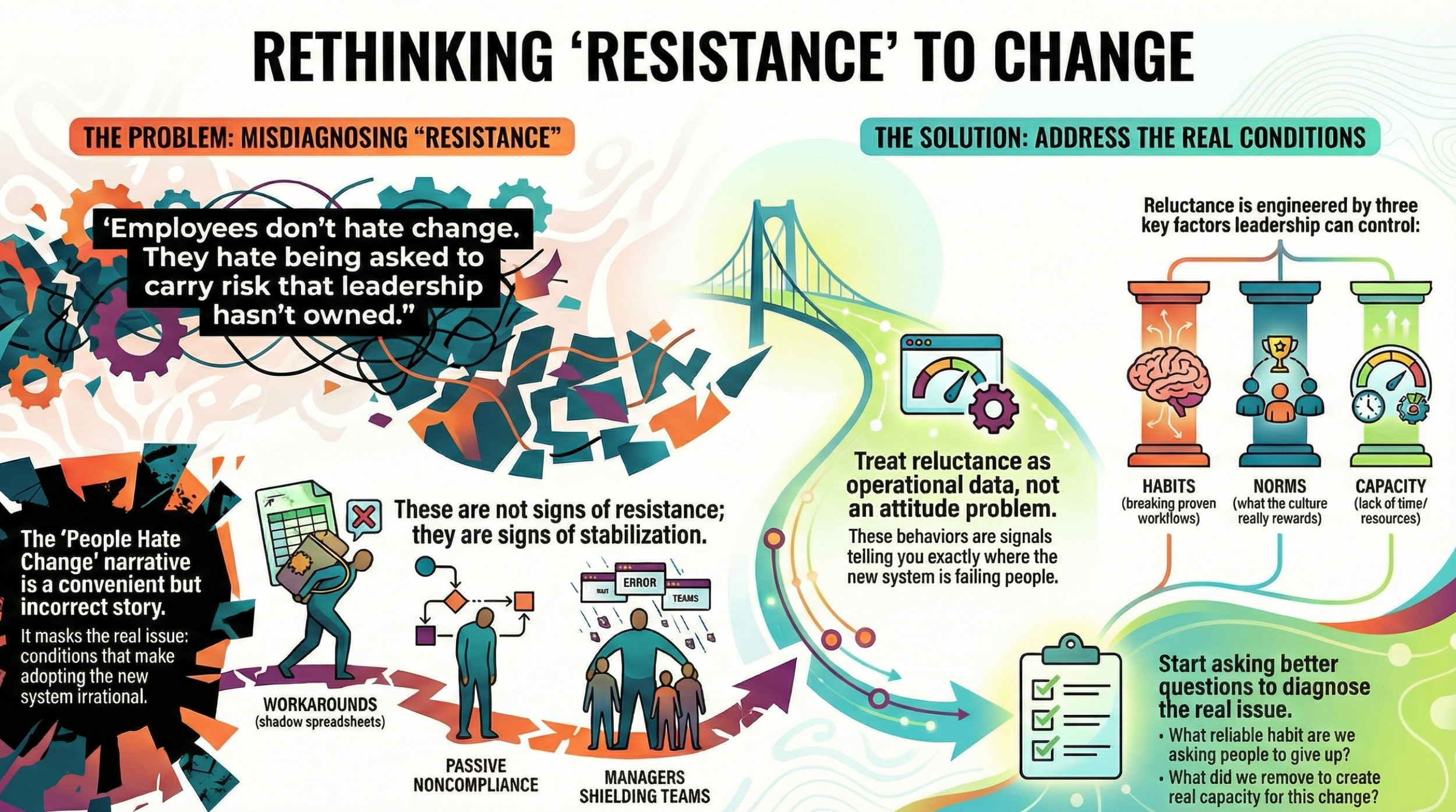
When executives misdiagnose reluctance as a mindset problem, they reach for the usual tools: more communication, more training, more reminders that the change is "important." Meanwhile, the frontline does what it always does when reality gets shaky. It stabilizes. And that stabilization shows up as the exact behaviors leaders interpret as resistance:
Workarounds. Shadow spreadsheets, side channels, unofficial steps.
Passive noncompliance. Nodding in meetings, quietly reverting later.
Managers shielding their teams. Slowing adoption, controlling exposure, filtering what makes it up the chain.
Those behaviors are data. They're telling you something specific about what your initiative is doing to the human system.
This is where we use The Five-Lever Framework, and why we structure our change work through Illuminate, Align, Architect, Activate, and Adapt. It forces the right question. Not "How do we overcome resistance?" but "Which conditions are making adoption irrational right now?"
Illuminate: Name the Real Behavior, Not the Narrative
Start here. What are people doing to keep the work from breaking?
In tech-mediated change, workarounds are rarely laziness. They signal that the new workflow is not yet dependable enough to carry the consequences of real work. You see this pattern in highly visible public implementations too. Reporting on the VA's electronic health record modernization has described ongoing operational problems and safety concerns during rollout, situations where staff are forced to compensate when the system doesn't reliably support care delivery.
Even outside healthcare, the pattern is the same. When a system introduces friction or uncertainty into high-stakes work, people create parallel paths. That's not "hating change." That's risk management.
So illuminate the actual behavior first. Then you can trace it to a lever.
Align: Reluctance Spikes When the "Means" Becomes the "End"
The first lever we look at is Intention.
Here's the executive trap. You start talking as if the goal is "implement the ERP" or "roll out AI." You don't mean it that way, but the organization hears it that way.
When the tool becomes the headline, you unintentionally send a message: compliance matters more than outcomes. And the frontline responds accordingly, by protecting outcomes through whatever means still works, whether it's officially sanctioned or not.
In the book Goal Systems Theory, the authors describe how people search for alternative means when their needs aren't met, and how they can get pulled back toward familiar options when new paths aren't accessible. In their words, there can be a "tyranny of the familiar."
That's what's happening in most resistance stories.
When the intended outcome is vague, people default to what they know will keep things moving. They chase ghosts of the past, not because they're backward, but because the new path hasn't been made usable and safe yet.
Executive gut-check: If you cannot clearly state the goal without naming the technology, you're not leading change. You're installing software.
Architect: Reluctance Is Usually Engineered by Habits, Norms, and Capacity
This is where reluctance is made. Not by attitudes, but by design.
Habits contain hidden competence. People don't just perform tasks. They perform sequences, shortcuts, timing, and judgment calls that only exist because the work has taught them what matters. That's competence. And it's usually invisible to leadership until it's disrupted.
When a new system breaks a reliable habit loop or replaces it with something slower, unclear, or inconsistent, the organization will build a new habit loop on the side. That's where shadow spreadsheets come from.
Norms determine what actually gets done. If the norm is "hit output targets no matter what," then you will get workarounds even if you beg people not to. If the norm is "don't bring problems unless you have a solution," then you'll get passive noncompliance and late-stage surprises. If the norm is "leaders announce and the floor absorbs," then managers will shield their teams because they know who takes the hit when things go sideways.
Capacity is math, not motivation. If you didn't fund the learning curve, people will protect throughput. If you stacked the initiative on top of an already-full load, people will triage. If you didn't remove competing priorities, people will wait you out.
This is one reason digital transformation planning fails when cross-functional operational realities aren't fully incorporated up front. The system gets built around assumptions instead of lived work, and adoption becomes expensive for the people doing it.
Activate: Attitudes Are Usually the Last Domino, Not the First
Attitudes matter, but they tend to be downstream.
If you repeatedly create priority churn, under-resource adoption, punish bad news, or declare victory based on "go-live" rather than outcomes, people learn a rational lesson: this initiative will not stick long enough to justify the cost of changing how I work.
So they stall. They comply performatively. They keep one foot in the old system. And managers, who are responsible for results, become the buffer that protects their teams from turbulence.
This is why we're blunt about something most organizations avoid saying out loud. If your strategy is underdeveloped, your organization will create reluctance as a survival strategy. Priority churn teaches waiting. Waiting becomes the norm. Adoption dies there.
Adapt: If You Want Adoption, Treat Reluctance Like Operational Telemetry
The fix is not selling the change harder. The fix is reading reluctance like a dashboard.
Workarounds, passive noncompliance, and shielding are telling you where the system is failing people.
This is why our method cycles instead of marching forward with a rollout plan and hoping belief catches up. We illuminate what people are doing to stabilize work. We align intention so the goal is measurable and human-relevant, not "install the tool." We architect the conditions around habits, norms, and capacity. We activate adoption in the workflow, not in a comms campaign. And we adapt fast based on the signals you're already getting.
A Quick Executive Diagnostic You Can Run This Week
If you only do one thing after reading this, do this.
Pick one initiative: ERP, AI, automation. In your next leadership meeting, take ten minutes and answer these questions out loud.
What outcome are we improving without naming the technology?
What reliable habit are we asking people to give up, and what replaces it?
What will people be rewarded for during the messy middle: throughput or truth?
What did we remove (work, metrics, priorities) to make capacity real?
Where are managers shielding teams, and what risk are they absorbing on our behalf?
If you can't answer these cleanly, reluctance isn't your problem. Conditions are.
And here's the punchline executives need to hear. Employees don't hate change. They hate being asked to carry risk that leadership hasn't owned.
Design the conditions that make adoption rational, and reluctance stops being a wall. It becomes guidance.
