

A Framework for Change That Starts With People
The Five-Lever Framework™ is a human-centered model for leading and sustaining transformation.
Built on decades of experience and informed by behavioral science, systems thinking, and organizational psychology, it bridges the gap between strategy and behavior, turning insight into action and action into measurable progress.
We Are So Glad You Found Us!
You recognized that there is a missing piece to the puzzle. You can see the finish line. You can feel it. But managing the change seems opaque - like there's something happening beneath the surface that no one is naming, tracking, or addressing.
You're right. There is.
What's missing is the behavioral layer- the one that determines whether any of that actually takes hold.

So Why Aren’t People Changing?
-
Is it because they don't understand the intention behind the change?
-
Is it because their habits are so deeply wired that new behaviors feel foreign and exhausting?
-
Is it because unspoken norms in your culture are quietly punishing the very behaviors you're trying to encourage?
-
Is it because they lack the capacity - time, tools, authority, or support - to do things differently?
-
Is it because their attitudes toward change have been shaped by broken promises, past failures, or legitimate fear?
It’s not about forcing compliance. It’s about building capability.
Change management has no shortage of models, but too many are linear, overly individual, or mechanically prescriptive.
Traditional models like ADKAR focus on what people must do, but not enough on why they can’t.
They miss the invisible forces that shape change outcomes: unspoken norms, entrenched habits, and limited capacity for adaptation.
The Five-Lever Framework™ was designed to fill that gap, combining structure with empathy, and analysis with action.
-
Clarity of purpose and shared direction.
Before people can move, they must know why.
We help leaders articulate intentions that connect meaning with measurable outcomes. -
The daily actions that make or break change.
Real transformation happens through consistent, visible behavior shifts — not slogans or slide decks. -
The unwritten rules that define what’s “normal.”
Every team has social agreements that shape what’s acceptable. Surfacing and reshaping these norms creates alignment and accountability.
-
The systems, autonomy, and resources people need to succeed.
Without sufficient capacity — time, skill, and trust — even the most motivated teams will stall. -
The beliefs and emotions that drive engagement.
Lasting change requires people to believe it’s possible and to feel ownership in the process.
Together, these five levers form a comprehensive map for understanding and guiding human behavior through change.
From Insight to Action
The Five-Lever Framework™ is applied through a structured methodology designed to move from understanding to execution:
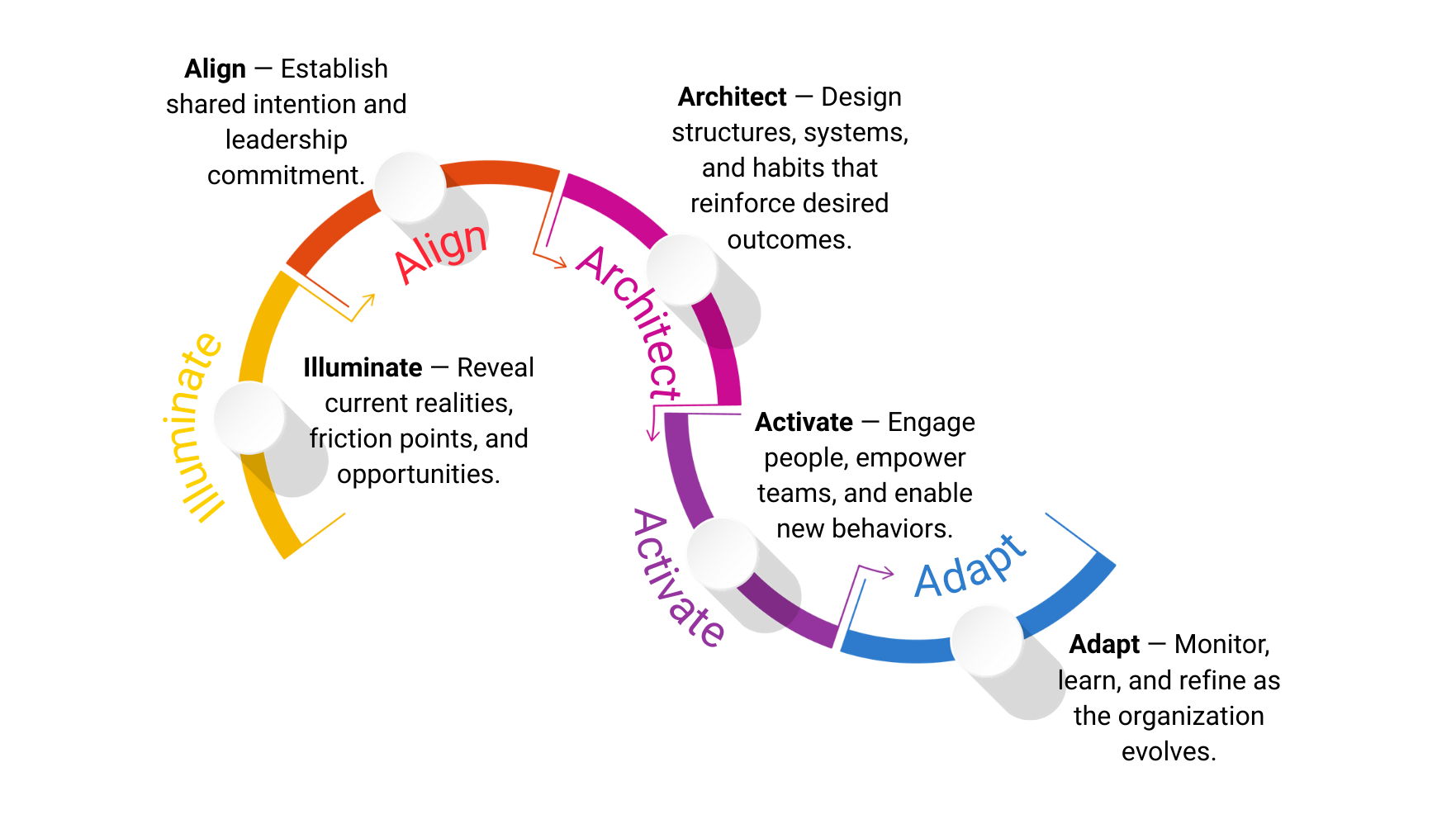
This cycle ensures change isn’t just launched — it’s lived.