

CHANGE ADOPTION · ORGANIZATIONAL CULTURE · BEHAVIORAL CHANGE
Is your change initiative at risk?
The majority of change initiatives fail at the adoption layer. The technology works. The people don't shift. The Change Risk Snapshot identifies which of the five behavioral levers are most exposed in your specific situation, so you can address the right risks at the right time and not after the fact. Know your risk before your rollout does.
Using The Five-Lever Framework™, we work at the intersection of strategy and organizational culture, helping people leaders and business executives
build the human conditions that make change adoption real.
What you’re up against
You’ve done what the playbook says.
You built a communication plan. You trained your people. You had executive sponsors. You made the case for change.
And yet, six months in, the new system is underutilized. The old process is still happening in parallel. The leaders are saying the right things in meetings and then going back to what they know. You're hitting milestones on paper. But nothing has actually changed.
This is not a strategy problem. This is not a talent problem.
This is a behavioral conditions problem.
70% of organizational transformations fail to achieve their objectives. You've probably heard that.
What you haven't heard is why in specific, diagnosable terms. The Five-Lever Framework™ provides that clarity:
The people who need to change don't have a clear enough picture of what "new" actually looks like (Intention gap)
Existing habits and workflows are competing with the new way every single day (Habit conflict)
The informal rules of the culture don't support the change leadership is trying to drive (Norm misalignment)
People lack the time, tools, or decision-making authority to actually behave differently (Capacity/Autonomy deficit)
Fear, distrust, or fatigue is more powerful than enthusiasm for the new direction (Attitude interference)
These aren't soft factors. They're diagnosable conditions. And when you know which ones are active in your organization, you know exactly where to intervene.
The Reality of Change
-
![An upset man sitting at a cluttered office desk with financial documents, a coffee cup, and multiple computer monitors displaying stock charts, holding his head with one hand.]()
Organizations spend over $1 trillion annually on change initiatives, yet studies show that approximately 70% fail to meet their stated objectives.
-
![Close-up of a laptop keyboard with backlit keys, viewed from a low angle in a dark setting.]()
When it comes to technology implementations specifically, 60-70% of technology ROI is lost because full feature sets aren't leveraged due to inadequate rollouts and poor adoption.
-
![A white jigsaw puzzle with one piece removed, revealing metal gears underneath.]()
Even with ERP and CRM systems that cost millions, studies show that 50-75% of deployed features remain unused - not because they're not valuable, but because people revert to what they know.
-
![An older woman with short gray hair and earrings is sitting at a table, looking at a laptop with a concerned or thoughtful expression.]()
Research consistently demonstrates that even when people have strong intentions to change, 28-69% still fail to act on those intentions.




We are change architects, not change managers
Change managers run process. Change architects design the conditions that make new behavior inevitable or diagnose why it isn't happening.
We work with SMB executives who are in the middle of high-stakes transformations: Ai implementations, operating model shifts, M&A integration, leadership transitions, and culture change. Organizations in manufacturing, operations, and complex industries where behavior on the floor or in the field is what actually determines ROI.
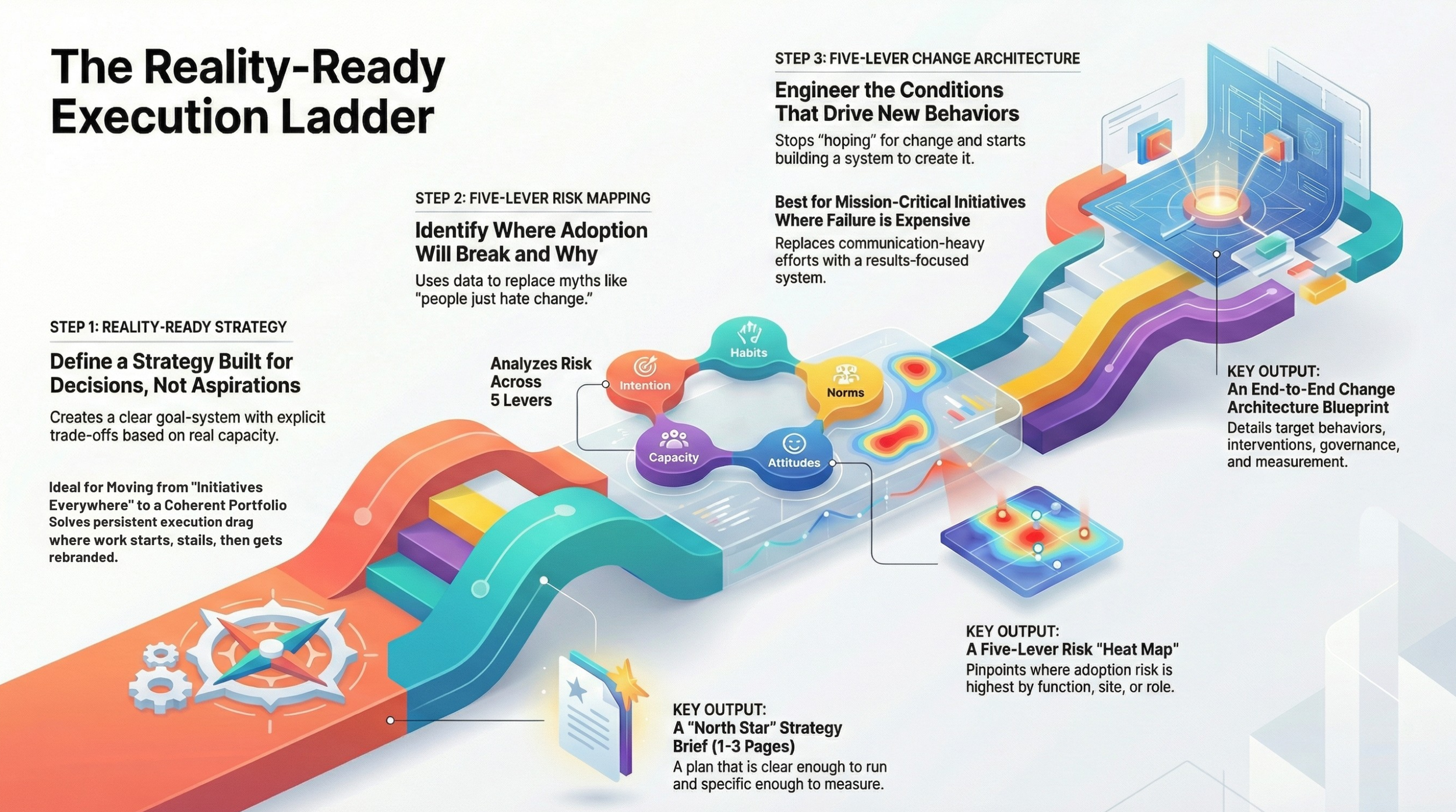
We do three things:
1. Reality-Ready Strategy Before you commit to a path, we pressure-test whether your initiative is set up to produce actual adoption or just project completion. This is triage for your change portfolio.
2. Five-Lever Risk Mapping We diagnose exactly which of the five behavioral conditions are misaligned in your current initiative and show you where adoption will break before it does.
3. Five-Lever Change Architecture We design the intervention system: sequenced, targeted, and built to produce measurable behavior change rather than activity reports.
Our Change Architects

Angella Dagenhart
Passionate about helping leaders build the conditions that make new behavior possible. She blends deep operations-side experience with human-centered change strategy to drive measurable adoption, not performative activity.
Co-Founder
Krista Beljan
Known for practical, people-smart change. She partners with executives to align intention with reality—turning ambiguity into clear choices, cohesive leadership, and sustained follow-through.
Co-FounderHow We’re Different
Most change models treat change as a communication problem or a training problem.
We treat it as a behavioral design problem.
The Five-Lever Framework™ is built on two decades of behavioral science research. It identifies five conditions that determine whether behavior changes in any organization.
What You Get
Depending on engagement type:
-
Surfaces the strategic choices available and names the decisions required before implementation can responsibly begin.
-
A written Five-Lever Risk diagnostic of which levers are misaligned and where adoption will break
-
A sequenced, lever-specific intervention design
-
Defining what "change has happened" looks like in measurable terms
-
Equipping your leaders to sustain the new conditions beyond the engagement
When all five levers are aligned: behavior changes. When any one is missing or misaligned: the initiative stalls, regresses, or fails quietly.
We don't assume. We diagnose. We design. We measure.
Ready to equip yourself to lead what’s next?
If you're tired of watching good strategies fail, if you're ready to address the human side of change with the same rigor you apply to the technical side, if you want to build sustainable transformation instead of managing perpetual crisis...
Let’s talk.
Because the finish line you can see? It's closer than you think. You just need to see what's actually standing between you and it.
And we can show you exactly that.